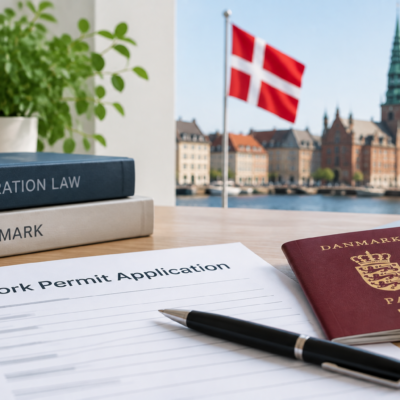

New collective agreement-based scheme for foreign labour in Denmark – What does it mean?
Denmark is in the midst of an important development when it comes to recruiting foreign labour. On 30 June 2025, the government launched a new collective agreement-based work scheme designed to make it easier for Danish companies to attract qualified employees from selected countries – but under Danish pay and working conditions.
This scheme has both labour market and political objectives: to strengthen companies’ access to labour while ensuring that Denmark maintains proper conditions and combats social dumping. In this article, you will get a clear explanation of what the new scheme means for employers, employees, and businesses in Denmark.
What is the new collective agreement-based scheme?
The new scheme means that Danish companies wishing to bring foreign labour to Denmark must, going forward, be covered by a collective agreement. A collective agreement is an agreement between employer and employee organisations that sets pay and working conditions within a specific professional field.
What is new is that only companies that have such an agreement can use the scheme to employ foreign workers under a more lenient salary requirement. The salary requirement in 2025 was DKK 300,000 annually, which was significantly lower than the Supplementary Pay Limit Scheme requirement of DKK 415,000 per year. The new rules apply in particular to nationals from a number of selected countries outside the EU, including the USA, the United Kingdom, India, Brazil, Ukraine, and several others.
The purpose of the collective agreement requirement is to ensure that foreign employees receive proper conditions that correspond to Danish standards – that is, the same pay, working hours, and working environment as their Danish colleagues.
Why is the scheme being introduced?
There are several reasons for the new system:
1. To ease recruitment without compromising on conditions
Denmark is experiencing a shortage of qualified labour in many sectors, especially in construction, production, and technology. By introducing a collective agreement-based scheme, companies gain better access to foreign employees, but with the requirement that they work under the same conditions as Danish employees.
2. To combat social dumping
Social dumping occurs when foreign workers work under poorer pay or working conditions than their Danish colleagues. To counter this, the new scheme is accompanied by initiatives such as the requirement for ID cards on larger construction and civil engineering projects. This is intended to make it easier for the authorities to verify that the labour is working under proper conditions.
3. To strengthen the Danish model
The Danish model is built on trust, collective agreements, and cooperation between employers and trade unions. By requiring a collective agreement for the use of the scheme, this model is supported and fair competition between companies is ensured.
Who can use the new scheme?
The scheme is still limited to nationals from selected countries outside the EU. These countries include, among others: the USA, the United Kingdom, Singapore, China, Japan, Australia, Canada, India, Brazil, Malaysia, Montenegro, Serbia, North Macedonia, Albania, Ukraine, and Moldova. In other words, companies recruiting employees from these countries will find it easier to bring the employee to Denmark on a work permit than would be the case if they applied under another work scheme.
In order to use the scheme, the company must also:
- be covered by a collective agreement with the Confederation of Danish Employers and the Danish Trade Union Confederation (or similar parties)
- ensure that the position is covered by this collective agreement
- comply with the pay and working condition requirements stipulated by the collective agreement.
This system is intended to ensure that foreign workers are not used as cheap labour, but are employed under proper conditions.
How does it affect work permits in Denmark?
The scheme also has significance for foreign workers applying for a work permit in Denmark. A lower pay or working condition barrier means that more job types can now qualify for residence and work permits if they are covered by a collective agreement.
At the same time, the scheme helps to stabilise working conditions for foreign workers, as pay and working conditions are defined through collective agreements – something that has not always been the case in the past.
Benefits for Danish companies
The new scheme means that companies with proper pay and working conditions gain better opportunities to bring in qualified foreign labour without having to navigate between several different immigration or salary schemes.
At the same time, the new collective agreement requirement strengthens these companies in the competition and provides a more stable labour base – both nationally and internationally.
How Copernica Law can help you
If you are a business owner, HR manager, or foreign worker, the new scheme may offer new opportunities — but also new requirements and documentation obligations. Legal questions regarding employment, work permits, collective agreement requirements, and social security can quickly become complex. The new rules will most likely also lead to stricter control of current and future salaries.
At Copernica Law, we are ready to guide you through the rules, assess your situation legally, and help you get the most out of the new schemes without making mistakes.
Do you have questions or would you like individual advice about your options in Denmark? Do you want to change jobs under the job change rule, or switch to another scheme? A lawyer in work permits, or a legal advisor in work permits, can help you all the way. Contact us — we will help you safely move forward with professional solutions.