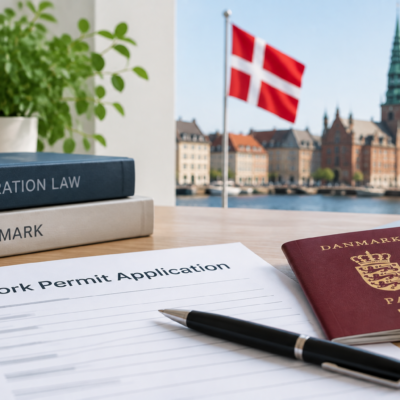


A job offer may look straightforward until the employer and workplace are described differently across the contract and work permit application. The contract may name a parent company, the application may name a subsidiary, and the employee may actually spend most days at a client’s office. These differences should be resolved before the application is submitted.
For a Danish work permit, the authorities need to understand who is employing the applicant and the work the applicant will perform. A clear description is especially important when several companies are involved in recruitment, payroll, management, or day-to-day supervision.
Identify the legal employer
Start with the company that will be legally responsible for the employment. Check that its name and registration details are written consistently in the contract and application. If the business uses a trading name, explain its relationship to the registered company rather than assuming the connection will be obvious.
An international group might have a Danish subsidiary, a foreign headquarters, and a separate company that administers payroll. In that situation, the documents should make clear which entity is offering the job and signing the agreement. The person reviewing the application should not have to infer this from a company logo or an email address.
Copernica Law’s guide notes that work applications generally involve an agreement with a company registered in Denmark, although some service-provider situations differ. The applicable arrangement should be checked against the specific work permit scheme.
Describe the actual workplace
Next, establish where the employee will carry out the work. A company’s registered address may differ from the office, production site, or client location where the employee will be based.
If the position involves several locations, describe the arrangement accurately. For example, a consultant may be employed by one company but regularly work at a customer’s premises. An employee may also split time between a Danish office and a home office. These details should agree with the role described in the employment documents.
Remote work from outside Denmark requires particular attention. A contract that simply says “remote” may leave unanswered where the work will be performed and how that relates to the proposed Danish employment. Ask the employer to describe the expected arrangement before the application is filed.
Check who directs the work
Reporting lines can help explain the employment relationship. Who assigns tasks, supervises the employee, approves leave, and reviews performance? The answer may be simple for a direct hire but less obvious for a placement involving a client or group company.
The application should reflect the real working arrangement. If the employee will be managed by a client while remaining employed by another company, the documents should explain each company’s role. Avoid describing the arrangement differently in a contract, employer statement, and application form.
This review is also useful for the employer. It gives the business an opportunity to confirm that its proposed workplace arrangements match what it can actually provide when the employee starts.
Make a final consistency check
Before submitting, compare the employer’s legal name, registration details, workplace address, and reporting arrangement wherever they appear. Check the employment contract, application fields, and any supporting employer letter together.
If a fact changes during preparation, update all affected documents. A revised workplace address in one attachment will not automatically correct an older address elsewhere. Keep the final signed versions together so both employer and applicant know what was submitted.
A work permit lawyer can review an arrangement involving multiple companies or locations and identify questions that need a clear explanation. People searching for a lawyer visa service should provide the proposed contract and a description of the actual workplace at the outset. That allows the review to focus on the real employment arrangement, rather than the job title alone.
FAQ
Why must the contract identify the legal employer clearly?
The authority needs to understand which company is offering and responsible for the job. The employer information should agree across the contract and application.
What if I will work at a client’s office?
Describe the arrangement accurately, including who employs you and where you will perform the work. Check that the application and employment documents give a consistent account.
Does the company’s registered address have to be my daily workplace?
The two addresses may differ. State the actual workplace clearly rather than using a registered office address without explanation.